Hillcraft › For restaurants › Food delivery app showcase
Food delivery & online ordering app · native iPhone · built and running
Your own delivery app —
that everyone can order from,
and everyone can pay on
This is Lokmera, a fictional restaurant brand we invented so we could show you everything at once. Every screen below is a real, native iPhone app, recorded as it drives itself: the menu, a checkout that changes with who is paying and where they are from, live courier tracking on the Lock Screen, and the kitchen, courier and owner sides. It ships as three apps from one codebase: the customer app, Lokmera Rider for your own drivers or runners, and Lokmera Restaurant for the kitchen and the owner. It speaks six languages, one of them right-to-left. Picture your name on it.
Made by Jordan Hill · Hillcraft, a UK software studio · hillcraft.dev
A demonstration — but real, and it exists.
Lokmera is not a real restaurant and this app is not in the App Store. It is a showcase of the kind of work Hillcraft is hired to do: the screens, layouts, animations, maps and Apple frameworks are all real code. Customers, prices and figures are sample data. No payment is taken anywhere in it — every authorisation step is a labelled demo, and each payment method below carries a plain statement of what works with Turkish providers today and what we would confirm first.
Watch an order happen, start to finish
A real recording of the app running on an iPhone: choose where the food goes, open a dish, build a basket, pay, and follow the courier along a real Apple Maps route until the order is at the gate.
Home → a pin, not an address → dish → basket → checkout → live tracking
Your customers, your data
Every order, phone number and favourite dish belongs to your restaurant, not to a marketplace that can show your customer a competitor tomorrow.
Beside the marketplaces, not instead
Keep the marketplaces for discovery. Move your regulars, your hotel and villa guests and your office orders to a channel you own.
Built around your kitchen
It connects to the POS, printers and couriers you already have, rather than asking your team to learn a new way of working.
One basket. Every honest way to pay.
Most ordering apps offer a card form and hope. This checkout knows who is paying: it ranks the methods for the customer’s country, opens each one into its own flow, and states the exact lira charge. The money always goes from the customer to your own account, through your own licensed payment provider. Hillcraft never touches it.
UK visitor → Turkish customer (instalments, meal cards, bank apps) → Russia → China → tip, promo code, pay
Card with 3-D Secure, saved cards and instalments
Visa, Mastercard and Troy with the bank’s 3-D Secure check, one-tap saved cards, and an instalment picker that appears only for a Turkish card. These are standard with Turkish providers such as iyzico, PayTR and Craftgate. Instalment options follow your bank agreement and sector rules.
Cash, the courier’s card terminal, a meal card — or a QR
Paying at the door is normal in Türkiye, so it is a first-class choice here: “bring change for ₺3.000”, a card on the courier’s terminal, a meal card, or a QR from the bank’s merchant app that Alipay, WeChat Pay and UnionPay users can scan. But a no-show at the door costs the kitchen, so the app nudges customers to prepay — which protects you. Couriers’ phone-as-POS apps in Türkiye run on Android.
Pluxee, Multinet, Edenred, Metropol, Setcard
Meal cards are how much of office Türkiye pays for lunch, and the marketplaces take them online. Issuers also accept online payments on approved merchant sites. You sign with each issuer; we connect it through your provider. No issuer publishes an open API, so we say “needs your agreement”, not “works out of the box”.
Masterpass, bex, GarantiPay, World Pay, Hepsipay, Paycell
The customer taps, their bank’s app opens, they approve and come straight back. These are offered through Turkish gateways once you hold the agreement with each bank or wallet.
Apple Pay for visitors’ cards — stated honestly
Apple Pay has not launched for Turkish-issued cards. Visitors already have their cards in their iPhones, and Turkish Airlines accepts Apple Pay from them today — but no Turkish payment provider publicly confirms it for ordinary merchants yet. The button in the app is Apple’s own; whether your restaurant can take it depends on your provider, and we confirm it with them before we promise it.
Alipay in the app; WeChat Pay and UnionPay at the door
One Turkish gateway lists Alipay for online payments, so we confirm it for your account first. WeChat Pay and UnionPay work face to face today through a bank’s merchant-app QR — which is why they sit under “pay at the door”, not in the in-app list.
Order together, pay separately
One link or QR. Friends add their own food in their own language, and each pays their own share their own way — Apple Pay, a German card, a Turkish meal card, cash at the door. Each share is an ordinary payment straight to your restaurant; the app never pools anyone’s money.
Also in the checkout
Tips, carefully
Courier and kitchen tips with one tap. Since January 2026 mandatory service charges are banned and voluntary tips are allowed, but card tipping through the restaurant is still being settled — so we switch it on only with your accountant’s approval, and we never distribute tips ourselves.
Company accounts & invoices
Office orders go on a monthly account, with the e-invoice issued through the e-invoice integrator you already use.
Promo codes, gift cards, points
Your campaigns, on your terms: a first-order code, double points on a quiet evening, a ten-lunch plan for long stays and offices, and a loyalty pass for Apple Wallet.
Refunds you can see
A missing dessert is refunded as one item, back to the way the customer paid. Partial refunds by API are documented by the Turkish providers.
No commission to us or a marketplace. Hillcraft takes no share of what your customers spend. You pay only your own payment provider’s normal processing rate, and the money settles to your own account. Provider names on this page are examples of Turkish providers, not partnerships.
🚫 What we deliberately did not build. No FAST / TR Karekod or “pay by bank” button: the infrastructure is live in Türkiye, but we found no provider offering it on a small merchant’s checkout yet. No crypto: using it for payments has been banned since 2021. No marketplace wallet: splitting money between a platform, restaurants and couriers is only legal through a licensed provider’s sub-merchant model — a single restaurant’s own app does not need it, and our software never holds, pools or pays out money.
An app a visitor can actually order from
I am from the UK. On holiday on the Turquoise Coast in September 2026 I could not order a meal from the local delivery apps — so I built the one I wished I had. It opens in the phone’s language, never asks for a Turkish mobile number, delivers to a pin instead of an address form, and shows prices in the customer’s own money with the lira charge stated.— Jordan Hill, Hillcraft
Welcome → language → checkout in their own money
The welcome screen greets them in their language and asks one thing — where they’re visiting from — then the whole app is set up for them: Sign in with Apple or a guest order, prices in their currency, and a checkout ranked for their country. The language switcher re-writes everything live, including Arabic, right to left.
- English · Türkçe · Deutsch · Русский · العربية · 中文
- Sign in with Apple
- right-to-left layout
No Turkish phone number
Yemeksepeti’s own help page says a membership cannot be created with a foreign phone number. Here a visitor signs in with Apple or an email, or simply orders as a guest.
A pin, not a postcode
Villa gate, sunbed 14, a boat at the quay, hotel room 508. The customer drops a pin and says what to look for; the courier sees it on the map.
Six languages, written by hand
English, Turkish, German, Russian, Arabic and Chinese, with the layout mirrored for Arabic. The app follows the phone’s language on first launch. Further languages are added the same way.
Prices they understand
Pounds, euros, roubles, dirhams or yuan on the menu, and at checkout the exact lira amount that will be charged. The exchange rates in this showcase are sample values.
The right way to pay, first
A card from abroad sees wallet and card first. A Turkish card sees instalments and meal cards. Cards issued in Russia are often declined abroad, so paying at the door comes first for them.
Notes that arrive translated
“No onions, please” written in German reaches the kitchen in Turkish. The menu assistant answers “what is künefe?” on the phone itself.
Six languages, switched live
Not a web page run through a translator: every string is written by hand and checked to fit, and the currency follows the customer.
Make it yours: the same app as three different restaurants
A charcoal grill and meze house, a fast-casual chain and a neighbourhood pide oven. Colours, typeface, photography and the whole menu change in one tap, because the app is built around a brand file, not around one restaurant. Yours would carry your name, your dishes and your photographs.
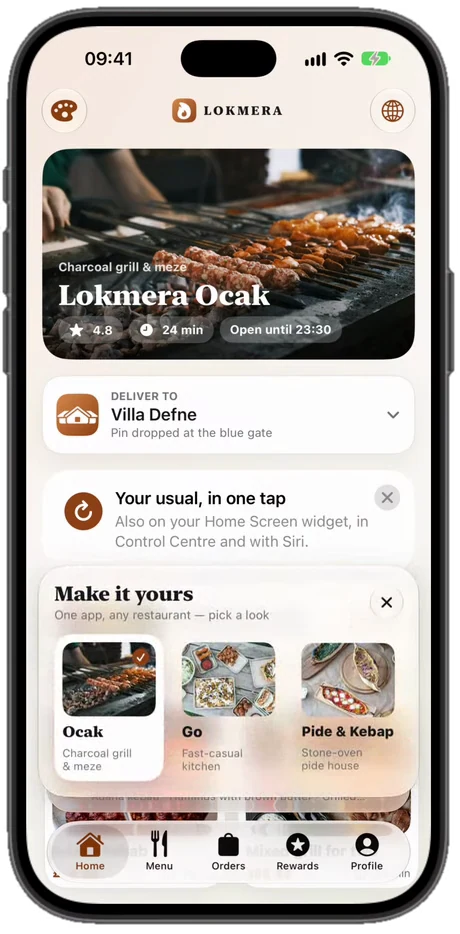
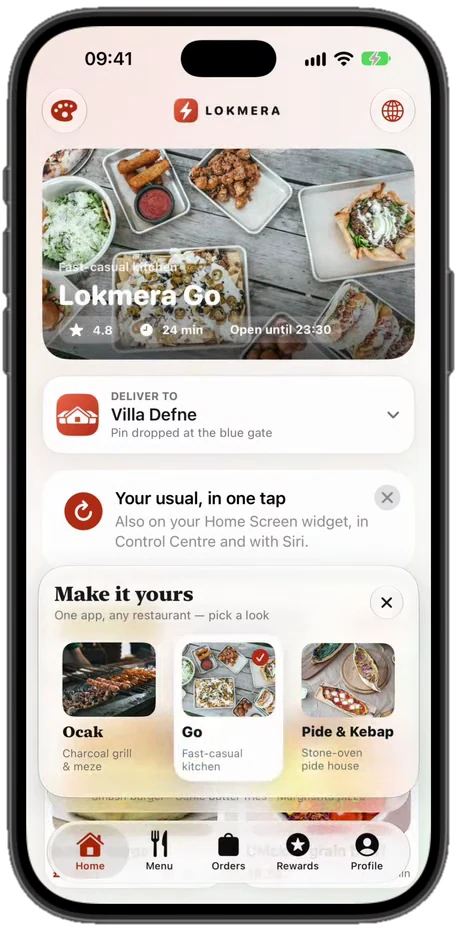
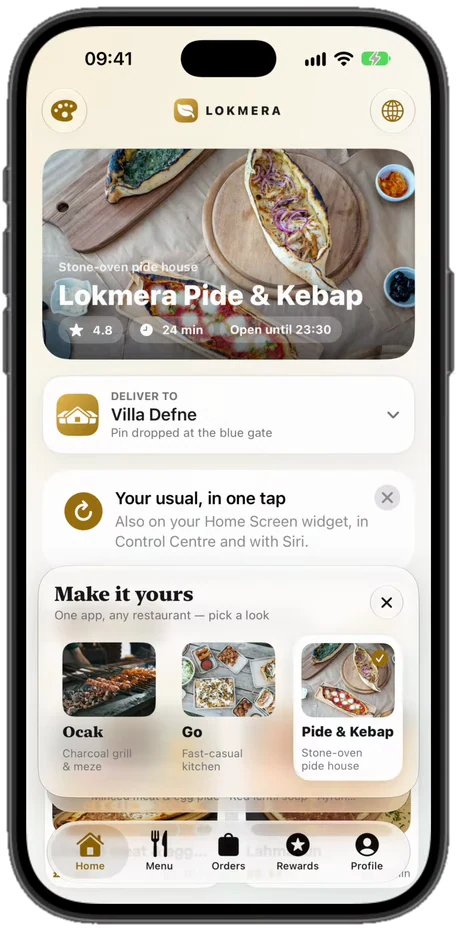
The part customers remember
Each clip is the app driving itself on Apple’s simulator — no taps, no cursor, nothing drawn on afterwards.
The courier on a real map, the order on the Lock Screen
A real MapKit map with a driving route from Apple Maps, a custom courier marker and a live ETA. The same order then runs as a Live Activity: stages, distance and countdown on the Lock Screen and in the Dynamic Island, in your colours.
MapKitActivityKit- sample location
- updates by push in a live build
Accept with a prep time, and the customer’s ETA moves
New orders ring in with the customer’s language and how they are paying. One tap accepts with a prep time, busy mode adds ten minutes everywhere, and “sold out” hides a dish from the app at once.
- notes arrive translated
- sample orders
Navigation, payment at the door, proof, and pay that adds up
An offer with the distance and what to collect, a route on the map, cash with the change worked out or a charge on the card terminal, a photo and the customer’s code as proof — then a Shift & pay timesheet: every leg (in to the kitchen, the wait, out to the customer), hours, kilometres, cash to hand in and itemised pay the owner approves. In Türkiye a restaurant often pays its own riders, and this makes that fair and verifiable — not a matter of trust.
MapKit- shift & pay timesheet
- cash & POS reconciliation
Scan the table, order, pay
A QR or NFC tag opens the menu instantly, App Clip style, for customers who will never install an app. In this showcase the App Clip card is drawn to show the flow; a live build registers a real one with Apple.
- App Clip card simulated
Ready for the folding iPhone before your competitors have heard of it
There is no separate “tablet version”. The same code fills a normal iPhone in one column and opens into two panes across the iPhone Duo’s inner display: the menu beside the live basket, the order beside the ways to pay.
Where it is going, the usual order, what is popular.
The order on one side, every way to pay on the other.
The numbers, the payment mix and the providers on one screen.
iPhone Duo layouts are tested on Apple’s simulator (Device Hub), not on hardware.
Every Apple feature earns its place
Each card says plainly whether it is real in this build or simulated because it needs your own systems.
Live Activity & Dynamic Island
Order stages, courier distance and a countdown on the Lock Screen (ActivityKit), in the restaurant’s colours.
real in this buildLive courier map
MapKit with a real driving route, a custom courier annotation, a following 3D camera and a live ETA.
real in this buildLiquid Glass throughout
The floating tab bar with the live order riding on it, glass filter chips, zoom transitions from a dish card into its detail.
real in this build“Reorder my usual”, everywhere
An interactive Home Screen widget, a Control Centre button, and Siri, Shortcuts and Spotlight through App Intents.
real in this buildApple Pay button
Apple’s own PassKit button. Taking the payment needs your merchant ID and a provider that supports it — see the checkout section.
simulated here · needs your systemsMenu assistant on the phone
Apple’s on-device Foundation Models answer typed questions about the menu; the conversation in the clip is a scripted sample.
real in this buildSix languages, right-to-left included
Hand-written strings, mirrored layout for Arabic, Apple’s own buttons localised with the app.
real in this buildApple Wallet loyalty pass
Points and a meal plan on a pass. The button is Apple’s; issuing the pass needs your Pass Type ID and a signing server.
simulated here · needs your systemsOwner dashboard with a 3D chart
Swift Charts and Chart3D: orders by hour, payment mix, where customers are from, a demand surface. All sample figures.
real in this buildApp Clip ordering
Scan, order and pay with no download. The card here is drawn; a live build ships a real App Clip target.
simulated here · needs your systemsiPhone Duo layout
Two panes across the fold, one column when closed, the tab bar becoming a side rail — from the same code.
real in this buildTips, haptics, dark mode, VoiceOver
TipKit onboarding, haptics on every confirmation, full dark mode and accessibility labels.
real in this buildCourier pay that adds up
The rider app logs hours, each leg’s distance and wait, cash collected and tips, then reports an itemised pay total the owner approves — built for paying your own drivers, verifiably.
real in this buildWhat does the commission cost you today?
Marketplaces publish no single rate. Press and the restaurant association TÜRES report deductions of roughly 30–40% when the platform’s couriers deliver and about 10% plus VAT with your own — and in April 2026 the Ministry of Trade made platforms itemise every fee, without capping commission. Put your own numbers in.
Your numbers, your channel
This is arithmetic on the numbers you enter, not a forecast or a promise. It leaves out what your own channel costs to run — couriers if the marketplace delivers for you today, and the app itself.
Revenue, payment mix, couriers’ pay and your providers, live
Orders and revenue today, how customers paid, where they are from, each courier’s hours and pay to approve, and a payment set-up you can change without touching the app: add a provider, and let an orchestration layer such as Craftgate or Lidio route each card and fail over when one provider stops answering. All figures are sample data.
Swift ChartsChart3D- provider-agnostic
Bespoke, built from the ground up, and yours
Money straight to your account
Through your own licensed Turkish provider. No commission to us or a marketplace — only your provider’s normal rate.
You own the app, the code and the data
Published under your own Apple developer account. Your customer list is yours to keep and to market to.
Connects to what you have
Your POS, kitchen printers, couriers, e-invoice integrator and payment provider — integrated, not replaced.
One brand file, many branches
A chain, a hotel group or a beach club with three kitchens: one app, each venue with its own menu, hours and couriers.
Native, fast, current
Written in Swift for iPhone, using this year’s Apple frameworks rather than a web page in a wrapper.
A studio, not a template
I run Hillcraft, a UK software studio, and I am Technical Lead at Arcade WOW, with nine years on Apple platforms. Work is delivered remotely from the UK.
Food delivery app — frequently asked
Can a restaurant in Türkiye have its own delivery app instead of only using Yemeksepeti, Getir or Trendyol Go?
Yes. Chains such as Domino’s, Little Caesars and Köfteci Yusuf, and TAB Gıda with Tıkla Gelsin, already run their own ordering apps. A bespoke app gives an independent restaurant, a small chain or a hotel group the same thing under its own name: its own customers, its own data, and payments into its own account. Most owners keep the marketplaces for discovery and move regulars to their own channel.
Which payment methods can a restaurant’s own app accept in Türkiye?
Through a licensed Turkish provider: Visa, Mastercard and Troy with 3-D Secure, saved cards, instalments, foreign cards, and wallets and bank apps such as Masterpass, bex and GarantiPay where you hold the agreement. Meal cards such as Pluxee, Multinet and Edenred need your own agreement with each issuer. Cash, a card terminal and meal cards at the door are normal. Apple Pay for visitors’ cards depends on your provider, and we confirm it before promising it.
Does Apple Pay work in Türkiye?
Not for Turkish-issued cards: Türkiye is not on Apple’s list of Apple Pay countries (checked September 2026). Visitors’ cards are a different matter — Turkish Airlines accepts Apple Pay from them on its website and app — but no Turkish payment provider publicly confirms it for ordinary merchants yet. We ask your provider first and only then put the button in your app.
Can tourists order without a Turkish phone number?
In an app built for them, yes: Sign in with Apple, an email address or a guest order, delivery to a map pin at the villa, hotel, boat or sunbed, the menu in their language and prices in their currency with the lira charge stated.
Do you take a commission on orders?
No. There is no commission to Hillcraft or to a marketplace. You pay your own payment provider’s normal processing rate, and the money settles to your own account. Hillcraft’s software never holds or moves customer funds.
How do couriers get paid if the restaurant runs its own drivers?
The rider app keeps an auditable shift: on-shift hours, each delivery’s distance and wait, cash collected at the door, tips, and an itemised pay total (per delivery, per km, hourly) that the owner approves. Cash, card-terminal slips and app payments reconcile to the lira, so paying your own drivers is fair and provable — not left to trust.
Can a group split the bill in the app?
Yes. One person shares a link or QR, everyone adds their own dishes, and each pays their own share by their own method. Each share is an ordinary payment to the restaurant; the app never pools money.
Is this a template or white-label product?
No. Lokmera is a showcase. Your app is written for your restaurant from the ground up — your menu structure, your kitchen routine, your branches — and you own the app, the code and the data. The three looks on this page show how far one code base can be re-dressed.
Does it work with my POS and my own couriers?
That is the point of building it for you. Orders can print in the kitchen, post to your POS and go to your own couriers’ phones. Which integrations are possible depends on the systems you run, so that is the first thing we look at together.
How do I start?
Send one message on WhatsApp or by email with your restaurant’s name, how orders reach you today and what the marketplaces cost you. I will reply with how I would build it for you and put together concept screens with your own name and dishes on them.